How to cut no-shows without calling every client
An empty slot costs more than the service you did not perform. Five methods you can automate, how to work out your own monthly loss, and why penalties come last.
Published by TimeNow
Written by the TimeNow team, a booking software provider. Comparisons explain selection criteria and information from the sources listed.
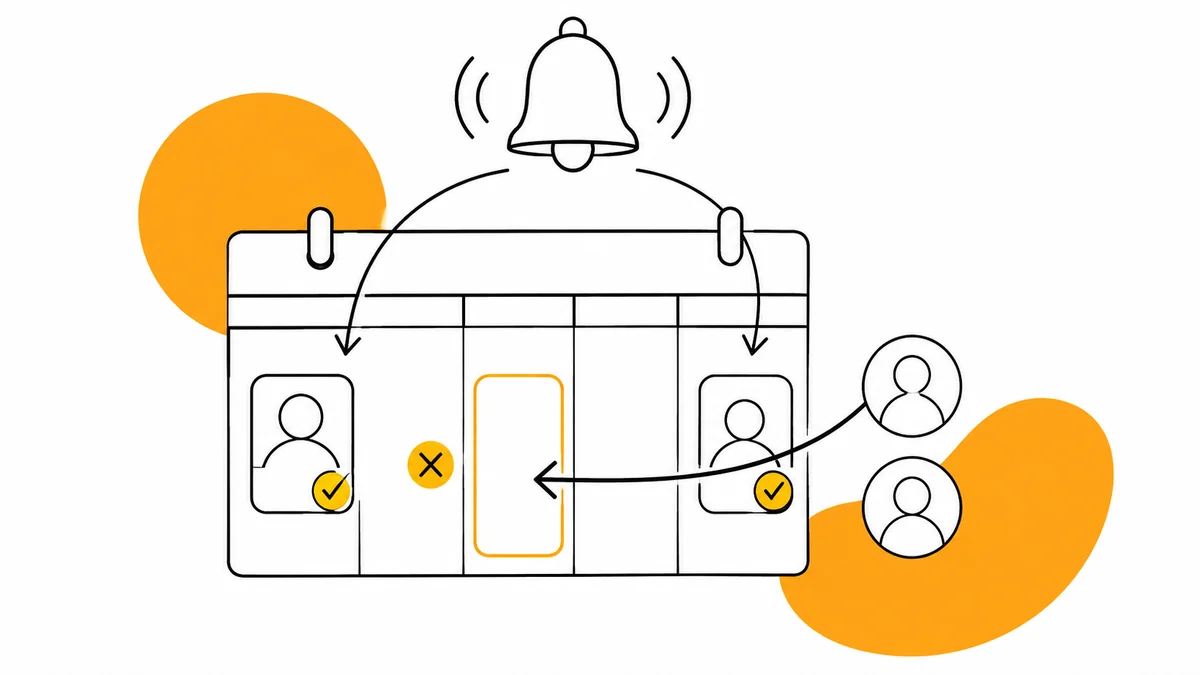
To reduce salon or studio no-shows, start with reminders, straightforward cancellation and rules explained before booking. For group classes, add a waiting list; then measure absences, timely cancellations and refilled places separately.
What an empty slot actually costs you
An empty slot is not just the service you did not perform. It is also the hour you paid your specialist for, and the client on the waiting list who would have come had they known. Before any method, work out your own loss — with your numbers, not a market average:
- Count the appointments in a normal month.
- Count how many did not turn up. If you do not record them, start this month — without that number the rest is guesswork.
- Multiply the no-shows by the average price of a service.
- Account for retained deposits, sessions consumed from prepaid packages and slots filled by another client; do not count them again as lost revenue.
Why clients do not turn up
Three situations worth exploring when you talk to clients:
- They forgot. The appointment was booked two weeks ago on a busy day. Fixed by a reminder.
- They cannot come and do not know how to say so. They would have to call, it feels awkward, they put it off, then they never call. Fixed by a cancellation link.
- They did not understand the booking rules. Explain the cancellation deadline and any deposit conditions before a reservation is completed.
Method 1: an automatic reminder 24 hours ahead
An automatic reminder around 24 hours beforehand can be a useful starting point. Include the time, service, address and cancellation link, then adjust timing to your policy and the outcomes you observe.
Choose a communication channel clients actually use, then measure delivery and outcomes. Do not assume one channel is more effective for every client or that a delivered message has been read.
An example that works — short, with no questions in it:
Hi Ana! See you tomorrow at 2:30pm for a cut and blow-dry, at 12 Example Street. If you cannot make it, cancel here: [link]. Thank you!
TimeNow supports WhatsApp and email notifications depending on configuration; see communication options. Test delivery, timing and the cancellation link with fictional details before enabling a rule for clients.
Method 2: one-tap cancellation
A cancellation twelve hours ahead is not a loss — it is a slot you can still sell. The problem is not that people cancel; it is that they do not. Make cancelling easier than ignoring the message, and you turn no-shows into openings you can fill.
- A direct link in the reminder, no account and no password.
- A clear cancellation window, stated at booking rather than at cancellation.
- The slot frees itself automatically in the calendar, not once somebody reads a message.
- A waiting list that notifies the next client immediately. Without it you have an empty slot you merely learned about earlier.
Easy cancellation plus a waiting list is the combination that actually recovers money. Cancellation on its own just delivers the bad news sooner.
Method 3: deposits, but only where they are justified
Deposits work. They also annoy people. The practical rule: ask for one where your absence costs a lot, not everywhere.
| Situation | Deposit? |
|---|---|
| Long, expensive service (colour, a 2–3 hour treatment) | Yes |
| New client, no history | Yes, a token one |
| Loyal client of several years | No |
| Short, inexpensive service | No — the annoyance costs more than the gain |
| Peak period with a waiting list | Yes |
Penalties applied after a no-show are a different matter and generally a bad idea with a loyal client: you recover the price of one service and lose someone who had been coming for three years.
Method 4: ask for confirmation only where it matters
Explicit confirmation adds a step for clients and staff. Consider it for appointments that need additional coordination, then check whether the responses actually help you manage the schedule.
Method 5: win the client back afterwards
A short, blame-free follow-up can give the client a simple route to book again. Use it where appropriate for your communication policy and measure results rather than assuming every recipient will return.
Hi Ana! Sorry we missed you yesterday. If you like, we can hold a slot for you next week — pick a time here: [link].
No "you did not show up", no "you cost us money". A client who feels judged does not come back, and you have already lost the hour — there is no sense in losing the person too.
The plan, in the order worth implementing it
- Start recording no-shows. One month. Without the number you cannot tell whether anything worked.
- Turn on the automatic 24-hour reminder, with the cancellation link in it.
- Enable the waiting list, so freed slots fill themselves.
- Add deposits only for long, expensive services and for new clients.
- Send the win-back message the day after every no-show.
- Measure again after a month and compare with step 1.
Frequently asked questions
How far ahead should the reminder go out?
Around 24 hours ahead can be a starting point if it leaves enough time to cancel and refill a place. Adjust timing to your business policy and measured outcomes rather than treating one interval as universally best.
Is an email reminder enough?
Rarely. Email often lands in a promotions tab and is read later than a message. If it is the only channel you have, use it — but do not expect the same effect as a message arriving where the client already reads their conversations.
Do financial penalties work?
They work on paper and irritate in reality, loyal clients most of all. A deposit taken up front is a much better instrument than a penalty applied afterwards: the first is a condition accepted at booking, the second is a punishment received after the fact.
How do I calculate my monthly loss from no-shows?
Multiply missed appointments by the average service value for a gross estimate. Adjust for retained deposits, prepaid memberships and refilled slots; the result is not automatically lost profit.
Can all of it be automated?
Notifications and cancellation can be configured in the system, while waiting lists apply to group classes. Check follow-up messages and deposit rules separately so the automation follows the policy communicated to clients.
Sources and documentation
- TimeNow — plans and pricingchecked September 5, 2026
- TimeNow — WhatsApp notificationschecked September 5, 2026